


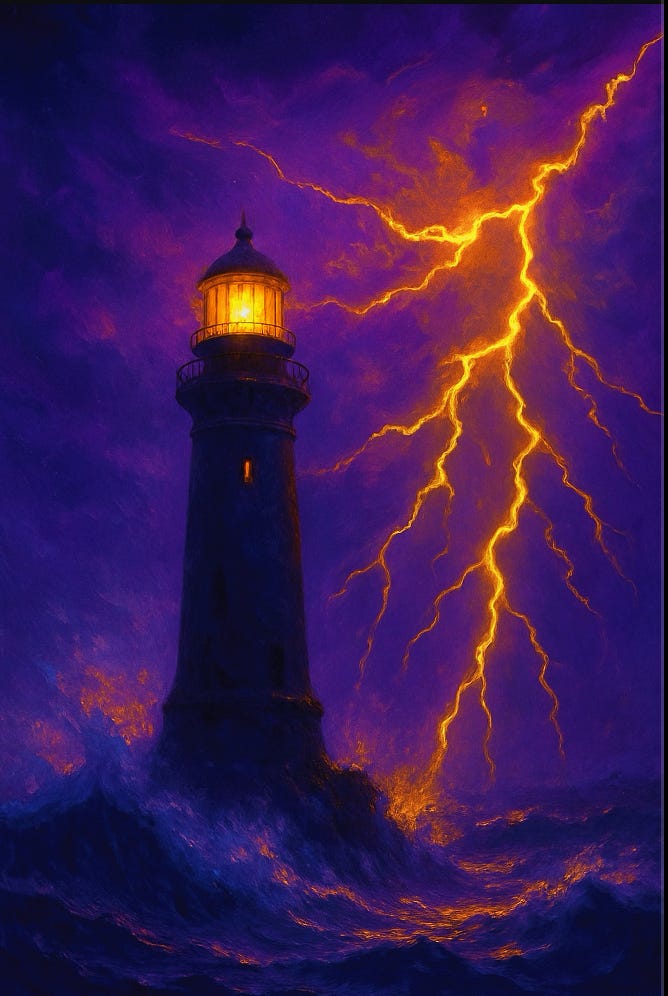
Hope is not a feeling.
It’s a choice I have to remake every time the world throws another match into the dry grass. I don’t wake up glowing. I don’t wake up serene. Most mornings, I’m just a person staring down a cracked horizon, deciding— again— not to look away.
People mistake hope for cheerfulness, for naïveté, for some pastel-colored spiritual bypass. They don’t understand that hope, real hope, is forged the same way steel is: pressure, heat, and a refusal to break.
Truth is, I didn’t get here by being naturally optimistic. I learned hope the hard way, the way people learn to build fires after too many nights freezing in the dark.
I. The Origin Story
For a long stretch of my life, if I didn’t leave a light on for myself, I would drown in the dark. Depression taught me that pessimism is effortless. It greets you at the door. But optimism? You have to drag that thing upstairs like a body.
At some point— quietly, without ceremony— I realized I had to become my own lighthouse. No one else was coming to pull me out. So I kept a little light burning in the corner of my mind, a flicker that said: Try again tomorrow.
It wasn’t pretty. It wasn’t profound. It was survival.
I joke that my sense of humor is dark because the alternative is crying at inopportune moments, but the truth is darker still: humor has always been a lifeline. A way to keep the grief from swallowing me whole. A way to refuse surrender.
II. The World We’re Living In
And now we’re all living through a time that feels like the prologue to someone else’s dystopian novel. Regimes tightening. Freedoms thinning. Politicians testing how much cruelty they can normalize before people notice the temperature rising.
Most days it feels like the air is humming with static— warning signs, headlines, deja vu threads from history repeating themselves in sharper tones.
Apathy has become a luxury item. Numbness is the new national pastime.
But despite it— despite the spiraling, the unraveling, the near-constant sense that we’re witnessing the era of endings— I still find myself reaching for that small, stubborn ember.
Because hope, in days like these, isn’t softness. It’s subversion.
III. What People Get Wrong About Hope
Hope gets misread so easily.
People think it means ignoring reality.
It doesn’t. It means staring reality in the face and refusing to let it decide who you will be.
Hope is not blind. Hope is bruised.
Hope is not passive. Hope is preparation.
Hope is not pretending everything is fine. It’s insisting that things can still change for the better.
Hope is endurance disguised as faith.
When I talk about believing in people, I’m not talking about some sunshine-and-warmth sentiment. I’m talking about a radical act of remembering—remembering who we still could be, even in the ruins.
IV. The Science of Staying Lit
There’s a strange kind of intelligence baked into hope.
The brain is wired toward meaning-making. Toward pattern. Toward the possibility that tomorrow might be different. Neuroplasticity itself is a vote for hope. The mind reorganizes. It learns. It adapts. It believes that change is possible even when experience argues otherwise.
And faith— religious or not— functions like internal architecture. A stabilizing beam. A quiet scaffolding the psyche uses to survive chaos.
Hope is not a glitch in human evolution.
It’s the feature that kept us alive.
V. The Nanny and the Nation
Working with children taught me something I wish I’d learned sooner: caring for another life forces you to imagine a future worth surviving. It makes you protective not just of a child, but of the world they’ll inherit.
In that sense, caretaking is political.
Love is political.
Optimism becomes a form of responsibility.
Hope isn’t an escape from reality.
Hope is how we stay anchored in it without collapsing.
VI. Hope as Resistance
Here’s the quiet part the authoritarians don’t want you to realize: regimes depend on despair. They thrive on the moment you stop believing change is possible. The moment you sink into numbness. The moment you give up.
Despair is hypnosis.
Hope is the slap that wakes you up.
Some days, hope feels like defiance.
Some days, like a matchstick.
Some days, like the last working radio tower still broadcasting through the static.
And some days, it’s just the smallest, almost-imperceptible decision to not shut down.
Some of us are still carrying matches.
Some of us are still leaving lights in windows.
Some of us refuse to let the world go dark.
VII. The Personal Promise
I don’t believe in hope because the world is good.
I believe in hope because the world is still capable of goodness—and that capability is worth fighting for.
I believe in staying soft even when it hurts.
I believe in telling the truth even when it ruins the mood.
I believe in choosing light even when it flickers.
I believe in protecting my future family with the fierceness of someone who knows exactly what darkness can do.
Hope isn’t my default. It’s my practice.
And I return to it the way some people return to prayer.
VIII. The Light Left On
So yes, the world feels ruined sometimes. And yes, I feel it too—the heaviness, the dread, the exhaustion of caring so much in a time that rewards apathy.
But I also know what happens when the light goes out.
I’ve lived in that darkness before, and I’m not going back.
I believe in hope because I know the cost of its absence.
I believe in hope because someone has to keep the signal alive.
I believe in hope because the world needs witnesses who refuse to go numb.
And until the tide turns—
until the future steadies—
until the bell rings louder—
I’ll leave a light on.
For myself.
For you.
For the world we’re still trying to build.
In light that refuses to die,
—Rebecca M. Bell
P.S.
Hope is the quiet rebellion.
A single flame saying—
not yet.

Filed under: Dispatches from the Lighthouse ✨