


The opposite of cruelty isn’t weakness; it’s care, sustained over time.
🕯️ We keep waiting for revolutions to look like fire— crowds, slogans, noise. But sometimes the most radical thing we can do is stay soft in a world that keeps trying to harden us.
The Misunderstanding of “Nice”
We’ve learned to mistake kindness for being nice. But nice is about comfort— it wants peace without honesty.
Kindness, on the other hand, tells the truth even when it trembles. Kindness can stand its ground. It can protest without cruelty, and protect without spectacle. It holds the door and the line. That’s what makes it dangerous to systems that depend on disconnection.
Niceness soothes the status quo. Kindness interrupts it.
Real kindness does not flatter power— it steadies the shaken.
Why Kindness Feels Radical
Cruelty has been professionalized. It’s automated, optimized, woven into the gears of everyday life. Indifference is the most reliable worker in any machine. So when you stop and see someone fully— when you offer softness instead of speed— you’re staging a quiet walkout from the culture of apathy.
Every small kindness disrupts the algorithm.
Every moment of care slows the churn.
We’re taught to think resistance must be loud, but a single tender act— unrecorded, unpaid, unpraised— is its own kind of refusal.
To notice someone is to declare them unexploitable.
The Economics of Empathy
Control depends on detachment. The powerful thrive on the illusion that we are alone— tiny islands of effort, competing for oxygen. But kindness collapses that illusion. It redraws the map. Suddenly the “I” becomes “we.”
It’s how every movement begins: before the marches, there were meals. Before the slogans, there were hands tending wounds. Before the manifestos, there were mothers, neighbors, lovers, friends who refused to give up on one another. The world doesn’t crumble because of cruelty. It crumbles when people stop caring.
Kindness is the mortar that keeps us from falling apart.
The Courage to Stay Soft
To stay kind in a cynical age is a kind of athleticism. It takes training to keep your heart open when you’ve been taught to close it for safety. Cruelty pretends to be strength. But it’s brittle— always in need of proving itself.
Kindness endures. It bends, rebuilds, keeps reaching back out. Cynicism feels sophisticated. But it’s a half-truth— the armor of those too smart to hope. Kindness requires more nerve.
It demands you believe, even after disappointment, that humanity is not a lost cause.
Softness isn’t weakness. It’s strength that remembers where it’s come from.
Practice, Not Performance
We don’t need to perform kindness; we need to practice it. Over and over. Quietly. Consistently. Feed people. Check on your tired friend. Give time instead of opinion. Listen longer than comfort allows.
Kindness is repetition— a small ritual of resistance against despair. The more we practice it, the less absurd compassion begins to look. And when enough people practice it, cruelty starts to sound like static.
Reflection
Think of the last time someone extended you a small kindness. A stranger letting you merge into traffic. A friend texting when you thought they’d forgotten. A softness you didn’t know you needed. You carried it, didn’t you? For minutes, maybe hours. Maybe still.
Now imagine that multiplied— an invisible chain of care spanning streets, screens, and kitchen tables. Would we still tolerate a world built on indifference? That’s the quiet revolution already underway. It doesn’t break the system in half; it erodes it grain by grain.
Until what’s left looks more like community than control.
A Call to Kindness
Before you close this tab— pause. Consider one act of kindness you could offer today. Not to prove a point. Not to post about it. But simply because it makes you feel human again.
Write the message.
Hold the door.
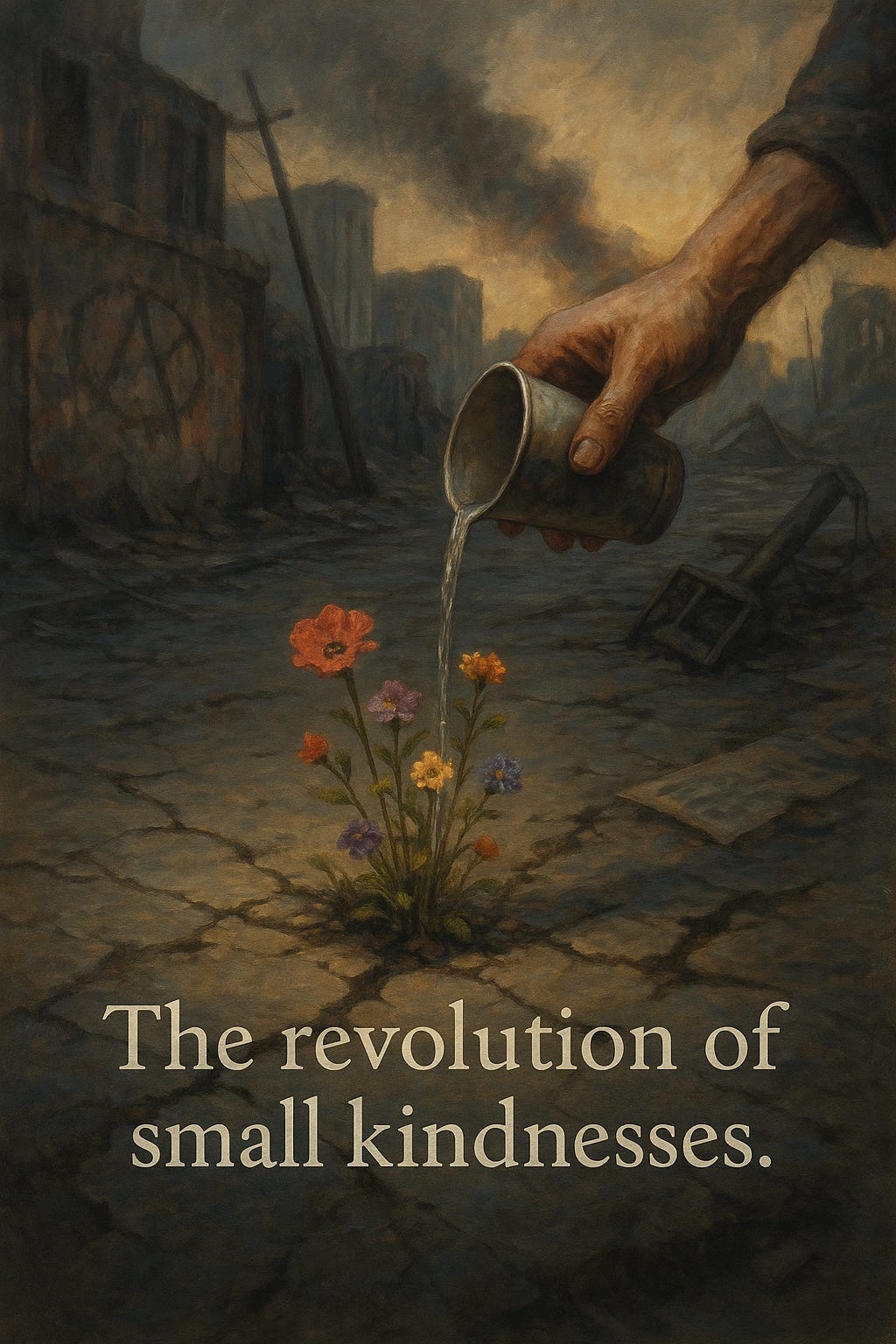
Water the flowers.
That’s all it takes. The future won’t arrive in a single spark. It’ll flicker to life in embers— small, steady, unstoppable.
Still watering the cracks,
—Rebecca M. Bell
www.rmbellwrites.com

Filed Under: Everyday Revolution, Humanity, Cultural Repair