THE FIVE SIGNS A REGIME IS FRACTURING
What Historians and Novelists See Before Collapse
Written by Rebecca M. Bell
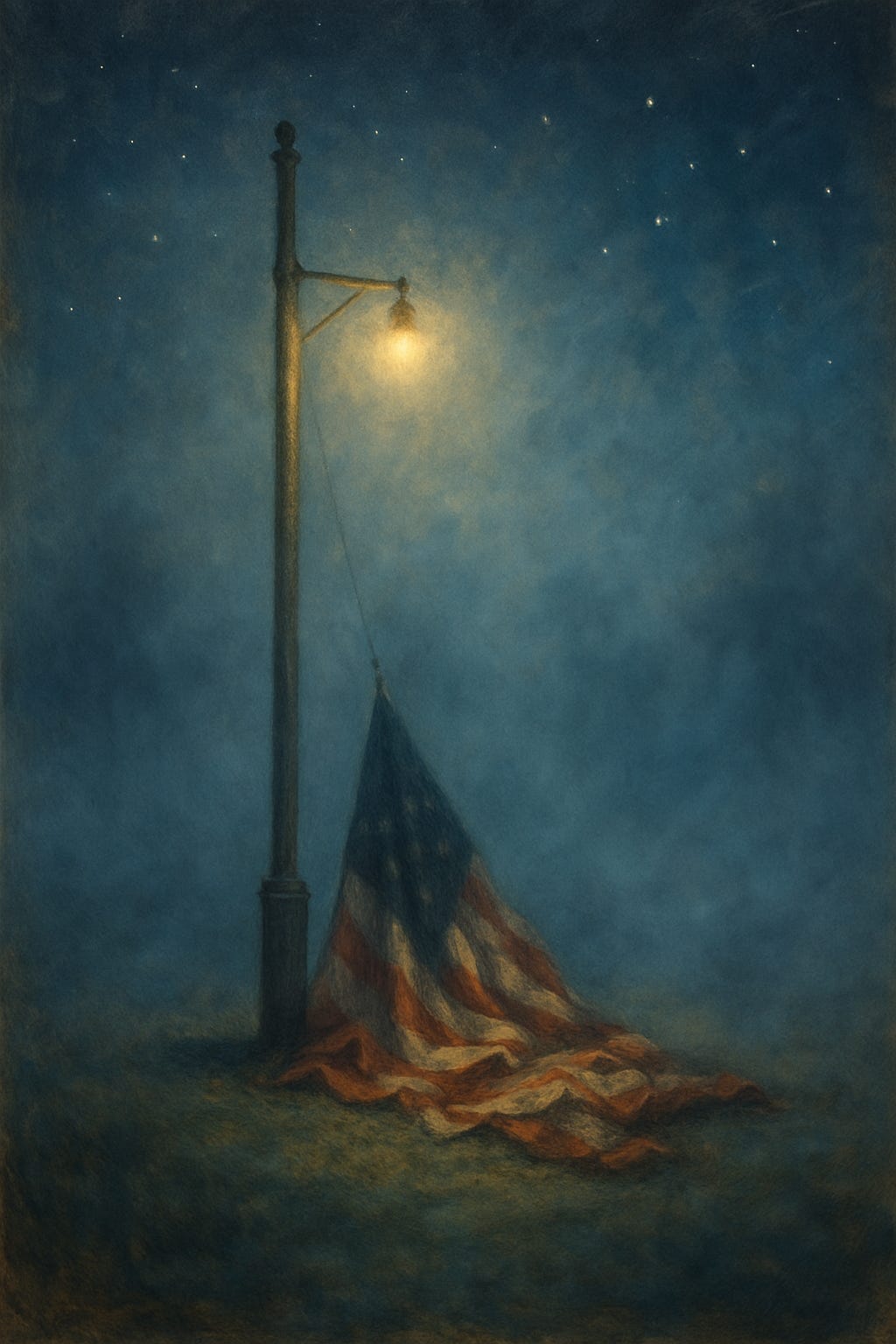
Dawn was still hours away, but the unraveling had already begun.
Power doesn’t crumble in a single, cinematic moment.
It unravels in patterns—small at first, then unmistakable, then impossible to deny.
Historians map these patterns with forensic precision.
Novelists translate them into myth.
And ordinary citizens—those who pay attention—feel the tremors in their chests long before the headline writers catch up.
Every collapsing regime carries the same fingerprints.
Every frightened government whispers the same warnings in its sleep.
These are the five signs scholars and storytellers look for when a system begins to fail from the inside.
I. When the Center Contradicts Itself
A stable government speaks in one voice.
A faltering one speaks in many.
Contradiction from the top is the first sign—the moment when the narrative buckles under its own weight. One day the crisis is a hoax; the next day, it demands urgent transparency. Leadership that was once iron-clad becomes improvisational, desperate to plug holes faster than new ones appear.
Authoritarian nostalgia always rewrites its own script, but when the rewrites pile up too fast, the myth collapses.
A ruler who looks unsure becomes a ruler who looks afraid.
And fear at the center is where collapse begins.
II. When Party Discipline Wavers
Regimes don’t fall when the people revolt.
They fall when the lieutenants stop following orders.
Every historian knows this truth: the moment loyalty becomes optional, the regime is already breaking. Votes fracture. Messaging splinters. Members of the ruling party quietly drift away like birds sensing a storm the sky hasn’t yet sewn.
This is the most dangerous moment for a leader—not because the opposition is strong, but because the inner circle no longer finds him worth protecting.
A king can withstand the crowd.
He cannot survive his own court abandoning him.
III. When Leaks Multiply and Lose Coherence
A government confident in its strength whispers with discipline.
A terrified one leaks like a punctured pipe.
Leaks—anonymous, frantic, contradictory—are not accidents. They’re the survival instincts of the powerful. Officials float trial balloons. They shift blame. They soften the public for what could be coming. They scramble to rewrite their own proximity to scandal before the fuse reaches their name.
This is the sound of a regime drowning in its own secrets.
Each leak a gasp.
Each contradiction a hand reaching for a different lifeline.
When the noise swells, collapse is no longer theoretical.
It’s already underway.
IV. When Foreign Allies Step Quietly Away
Foreign governments are the world’s most observant creatures.
They don’t wait for the fall—they prepare for it.
When a regime begins to fracture, its allies don’t thunder in condemnation. They simply drift. Diplomatic language cools. Statements soften. Distances widen. Nobody wants to be caught too close to a scandal that might scorch across borders, reputations, institutions.
The withdrawal is subtle but unmistakable:
the way a flock lifts from a field before the predator emerges.
Allies protect themselves first.
If they begin to retreat, it’s because they believe the collapse isn’t hypothetical—it’s imminent.
V. When Security Theater Rises and Actual Control Falls
Strong regimes don’t raise their voices.
Weak ones shout.
When a government begins to fray, it turns toward spectacle: proclamations, rallies, sudden bursts of patriotism, grand gestures meant to signal strength. But beneath the performance, the machinery rattles. The more desperate the theater, the weaker the spine.
A government that fears it’s losing control tries to flood the stage with noise.
Flags waved harder.
Speeches delivered louder.
Enemies named more frequently.
It’s the final instinct of power in freefall—
to look unbreakable precisely when it’s cracking open.
The Unmistakable Pattern
Put together, these signs form a constellation, a shape historians recognize instantly:
Contradiction.
Fracture.
Noise.
Distance.
Theater.
It’s the anatomy of a regime outliving its own myth.
Collapses are rarely sudden.
They are accumulations—
quiet moments of doubt,
private panic behind closed doors,
the slow recognition that loyalty has limits
and that the truth, once cornered, bares its teeth.
People imagine collapse as a bang.
Historians know it whispers first.
What matters now is not cheering the downfall of any one leader or party,
but learning to read the signs—
so that when power begins to warp,
we recognize the shift,
we brace for the dawn,
and we choose what kind of country rises from the dust.
The warning signs are here.
The patterns are old.
The story, as always, belongs to those who dare to tell it.
Author’s Note:
History doesn’t arrive all at once.
It leaks in through the seams—
in contradictions, in whispers, in moments that shouldn’t matter and yet do.
These signs aren’t predictions; they’re patterns, echoes of every government that ever thought it was unshakable until it wasn’t.
My hope in writing this piece isn’t to celebrate collapse,
but to remind us that we are never powerless observers.
The shape of a regime is defined as much by the people who watch it
as by the people who lead it.
If we can recognize the warnings,
we can reclaim the narrative.
We can decide what comes after.
We can choose a future that doesn’t repeat the past.
May we read the signs with clarity,
speak with courage,
and remember that silence has never once saved a nation.
Sometimes things burn so we can rise from the ashes.
—Rebecca M. Bell
Filed Under: Pre-Collapse Cartography, American Mythology (unraveled)


