


🪓
The Family Tree Is Rotting
—on bloodlines, beatings, and what we carry
Written by Rebecca M. Bell
Filed Under: “My genes are messy,” things we aren’t supposed to talk about, God, Guns, trigger warnings, & generational trauma
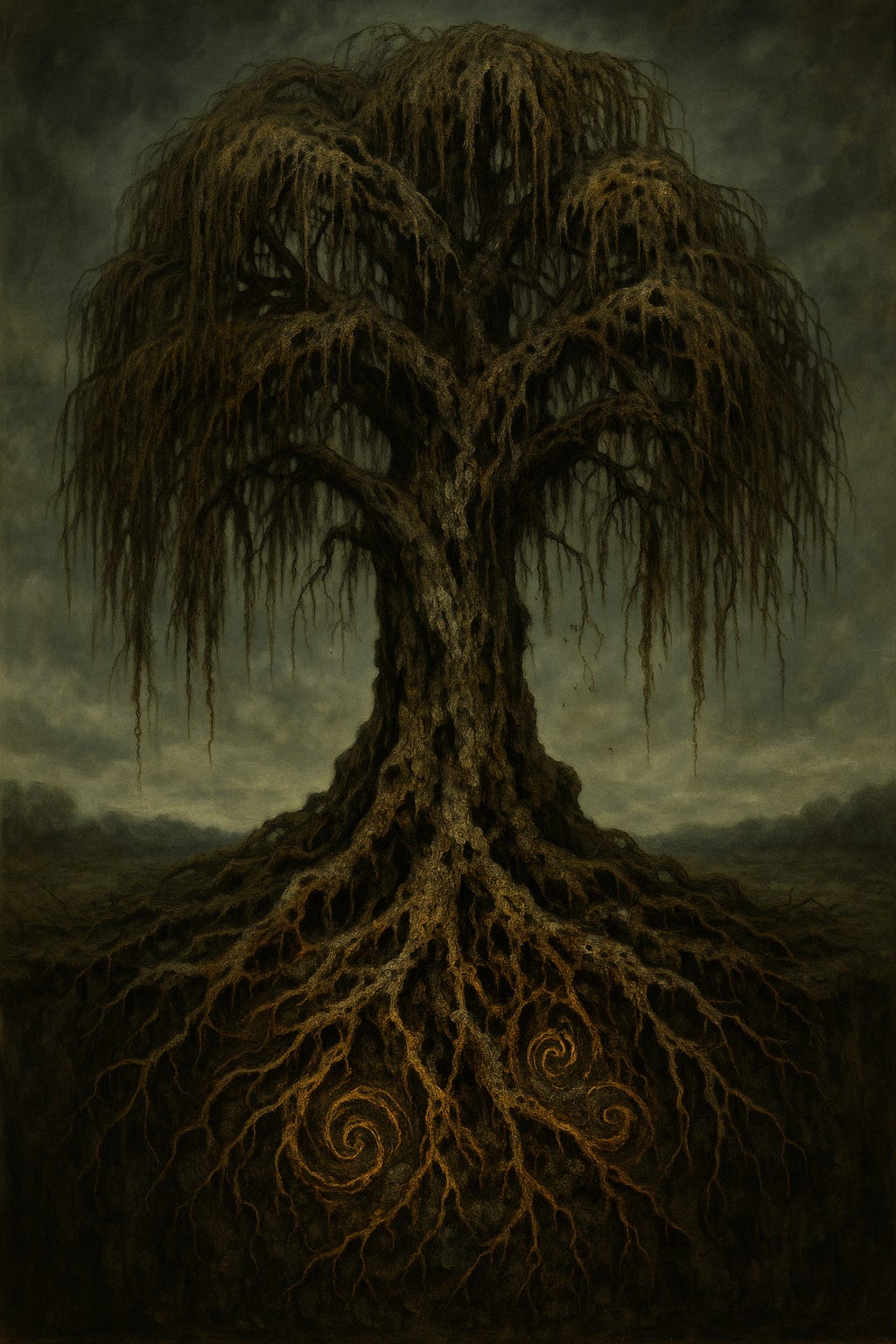
The deeper you dig, the more the spiral reveals.
But not all gold is good.
I don’t know exactly what I’m trying to say.
But it’s been swelling in my throat for years, and I think I’m finally ready to cough it up.
All I know is this: my genes are messy.
Not in a cute, quirky way—like “haha I can’t digest gluten”—but in a “my bloodline is a haunted archive of untreated grief, inherited rage, and unspoken violence” kind of way.
I come from white, Catholic, working-class Oklahoma.
I was raised by people who were raised by people who didn’t believe in therapy, but deeply believed in shame.
On both sides of my family tree, the roots are twisted.
There is substance abuse.
There is child abuse.
There is mental illness, unspoken and untreated.
There is God. And there is silence.
And behind all of that, there are stories.
Stories whispered around kitchen tables.
Stories tucked between nervous laughs and funeral casseroles.
Stories that were passed down like recipes—only nobody wanted to be the one cooking.
Here are just a few.
🪦 My great-grandmother beat the family dog to death with a mop.
That’s not an exaggeration.
That’s what happened.
She came home to find that the dog had killed all the chickens. Which meant there would be no eggs. No food. No money. No future.
So, in front of her young children, she took a mop and beat the dog to death.
My dad tells this story matter-of-factly. He adds, “Well, when your dog kills all your chickens, you don’t get to eat for the next few months.”
And he’s not wrong about the desperation.
But I want to say this clearly:
Hard times never have—and never will—justify cruelty.
Poverty is brutal. Starvation is real.
But cruelty is a choice.
And when that choice is made in front of children, it leaves a mark deeper than hunger.
I think about that dog a lot.
Tail probably still wagging—
Not understanding why the hands that once fed now struck with rage.
And I think of the kids—my ancestors—learning in that moment that love has limits. That survival means silence. That violence can look like protection if you’re too afraid to look directly at it.
It breaks something in me.
Because that mop wasn’t just about the dog.
It was a symbol of what desperation does to a mother—when a system has already failed her, and she’s been taught to turn her pain into punishment.
🪑 My grandpa had three sisters. He took the beatings.
His father was a drinker—an angry one.
He’d come home mean. And because my grandpa was the only boy, he was the target. The outlet. The punching bag.
My mom told me once that he wasn’t even allowed to use the indoor chamber pots—but he was made to clean them.
I think about that a lot.
A child scrubbing filth he’s not allowed to create.
A little boy trying to stay useful, so he doesn’t get hit.
He never talked about it. He’s never been much for emotional depth.
Our conversations, even now, are short and repetitive: “You gotta keep an eye on this one,” he’ll say with a grin when I walk into a room.
But that boy is still inside him.
And I wonder how much of that pain lives in me, too.
🪵 My other grandma got in a fist fight with her mother.
As a teenager.
It wasn’t verbal—it was literal.
And before that, she’d already learned how to pick the right kind of stick for a beating.
They made the kids go out to the tree themselves and choose it. That was part of the punishment.
But not just any stick. You had to know what kind would hurt the most.
Too small, and it would act like a whip. Those left welts. You only made that mistake once.
It was a test. A trap. A tradition.
And somehow, at the time, it passed for parenting.
I come from these people.
They loved in the only way they knew how.
But I was not born from peace.
And when I say, my genes are messy, this is what I mean:
I carry the trauma of people who didn’t have the tools to heal.
Who were more familiar with rage than rest.
Who coped with silence, and Jesus, and alcohol, and fear.
I carry their blood, but also their bruises.
When I first learned the phrase intergenerational trauma, it felt like a fog lifted.
Suddenly, my triggers weren’t just “personality quirks.”
My people-pleasing wasn’t a cute trait—it was a survival skill.
My inability to relax? A nervous system taught to stay alert.
And the more I learned, the more I saw it everywhere.
Not just in me.
Not just in my family.
But across nations. Across identities. Across borders.
🇮🇱 The State of Israel is trauma playing out in real time.
There is a kind of trauma that gets buried.
And there is a kind of trauma that builds a military.
I watch the world, and I see the ripple of unhealed wounds shaping policy, building walls, dropping bombs.
I think of one Jewish woman who had posted her 98% DNA test results in a Tiktok video—unusual and alarming, unless you understand what centuries of forced endogamy, persecution, and genocide will do to a people trying to survive.
And I find myself wondering—how much inbreeding happened among white Christians, too?
How much purity was demanded not just by blood, but by belief?
We like to talk about eugenics like it’s a historical footnote—some twisted Nazi science.
But I look around at the world I was raised in—the white, Christian, patriarchal stronghold of middle America—and I see the remnants everywhere.
Wasn’t whiteness itself a eugenic invention?
A manufactured hierarchy designed to erase difference, enforce conformity, and breed out deviation?
💊 Meanwhile, capitalism monetizes our suffering.
Mental illness? There’s a pill.
Addiction? There’s jail.
Trauma? There’s a wellness influencer ready to sell you a course for $499, if you act fast.
My ancestors didn’t believe in therapy because they couldn’t afford it.
Now therapy is a luxury, marketed with soothing fonts and pastel Instagram quotes.
The world wants you broken—because broken people buy more.
So I return to the question:
What exactly have I inherited?
My eyes? My laugh?
My fierce love for animals?
My deep suspicion of organized religion?
My tendency to panic when the room goes quiet?
All of it? None of it?
I don’t know where my family ends and I begin.
But I do know this:
I am not the beginning of anything.
I am the consequence.
The bruise on the bloodline.
The haunted whisper in the family recipe.
The one trying to name the thing they were told to never speak aloud.
I was not taught to heal.
But I am trying.
And maybe, if I name it clearly enough—
I’ll stop passing it on.
🕯️ If this essay resonated with you, consider sharing it or leaving a comment below.
New here? Subscribe for more protest-poetry, modern philosophy, and untanglings of the inherited kind.
Still glowing in the dark,
—Rebecca M. Bell
P.S. On Legacy
This body is a memory
they never meant to pass down.
Still, I hold it—
rot, root,
and the refusal
to hand it off again.
