


Some empires end with declarations; others end with décor.
This scene is not prophecy, nor threat, but reflection. The Big Beautiful Ballroom exists nowhere real and everywhere familiar— a monument built from greed, mirrors, and borrowed light. It burns not by hand but by consequence.
For those who’ve ever watched power gild itself while hunger growls at the door— consider this a requiem. A little therapy disguised as fiction.
(Excerpt from my upcoming novel, “Welcome to Wonderland”— a speculative archive of collapse, resistance, and rebirth.)
A record of beauty learning the cost of itself.
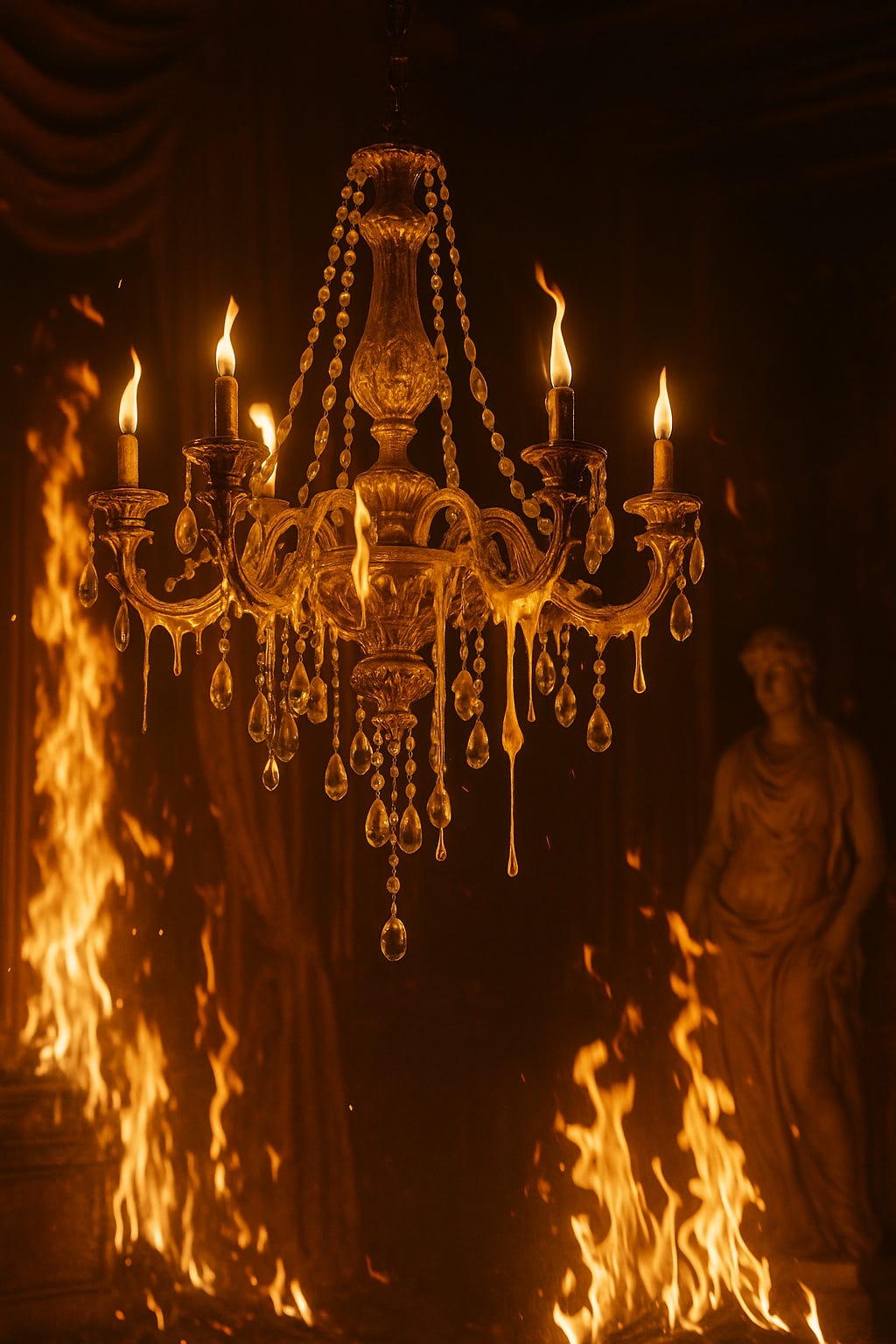
Decadence doesn’t die quietly. It drips.
The Big Beautiful Ballroom— Burning
(Alice, in the archives of memory)
The chandelier fell like an accusation, a slow, glittering verdict that forgot to be polite.
Heat breathed against the silk walls; gold vines wept down them in soft, obscene tears. Each drop landed with the faint, traitorous clink of coins remembering what they once were—ore, not ornament.
The portraits blistered first. Monarchs and ministers, all lacquered smiles and powdered deceit, began to sweat through their frames. Oil cracked under heat, and their eyes— those painted, eternal eyes— finally looked afraid.
Velvet burned next, sweet and thick. The smell was unbearable: perfume and ambition rendered into smoke. The marble statues didn’t scream, but something in their silence did. Their polished hands, once raised in blessing, blackened into gestures that looked like surrender.
Alice stood near the door, notebook trembling, ink beginning to run. The ledger she’d kept for years—every decree, every lie catalogued—curled at the edges as if trying to flee its own complicity.
The heat grew articulate. It spoke in crackles and sighs, reciting the inventory of everything that had ever been hoarded. The grand piano split down the center, ivory keys shrieking like teeth in confession. Champagne bottles burst one by one, their corks firing through the air like panicked doves. A mural of prosperity peeled away from the plaster, revealing the rot beneath—a history painted over too many times to count.
Gold leaves fell in flakes. Pearls hissed as their threads snapped. A thousand embroidered initials—stitched into napkins, monograms, the backs of chairs—unraveled into smoke. Each letter twisted upward, returning to the alphabet, free at last from the tyranny of names.
The orchestra pit collapsed into itself. Violins, still tuned for celebration, curled into black shapes that looked like question marks. Alice could smell sugar burning—the banquet tables surrendering their sweetness, their abundance charred into honesty. The mirrors along the walls burst, one by one, like old lies denied their reflection.
She wrote as she watched, her ink melting into the page, words liquefying into something that wasn’t quite language anymore. It felt right.
The empire had always spoken in gold and silence; now it was fluent in flame.
The rafters groaned. Dust descended like snowfall. For a brief and merciful instant, the fire caught the light just right, and every ember looked like forgiveness.
Outside, the city went on pretending. Buses sighed. Someone’s radio stuttered through static. The world, polite as ever, looked away.
Inside, the glass ceiling gave. It rained diamonds— counterfeit stars tumbling through the smoke. For a moment they were beautiful again, freed from ownership.
Then came the collapse—slow, thunderous, final. The chandelier’s corpse cracked open, spilling gems that no longer mattered.
When the last beam gave, the roar was almost tender.
Alice didn’t move. She watched the ballroom die the way historians watch empires: with reverence, with exhaustion, with a terrible kind of hope.
Outside, no one screamed. They only stared, eyes glassed by reflection, warmed by something dangerously close to relief.
Inside, the fire finished its meal. And for the first time in the history of the Big Beautiful Ballroom, everything inside it finally belonged to everyone.
By morning, the air had thinned into something almost merciful. Ash drifted like gray confetti, a celebration the city didn’t remember throwing. The ballroom was a hollow ribcage of stone and soot, sunlight bleeding through the fractures.
Alice stepped carefully across what used to be the threshold. Gold had cooled into dull, twisted ribbons. Glass crunched under her boots— the sound of luxury learning humility. The air still smelled of perfume, sugar, and endings.
She set her notebook on a slab of marble that had survived the fall and began to write again. The pen dragged, clogged with residue, but it obeyed. Architecture is confession, she wrote. And the fire only ever tells the truth.
In the distance, bells were ringing— not alarms, but something older, almost liturgical. A requiem for excess. A summons for whatever comes next.
Alice closed the book. The page was warm. And the world, for once, was honest enough to touch.
I wrote this scene as an act of exorcism—a record of the moment excess confessed itself. The fire, as always, is metaphor— though metaphors have teeth.
Art isn’t an act of destruction; it’s an act of remembering what deserves to be rebuilt.
If this piece stirred something in you— rage, grief, relief— good. Let it burn in language, not in the streets. Then, from the ash, write something of your own.
—Rebecca M. Bell
Coming Soon:
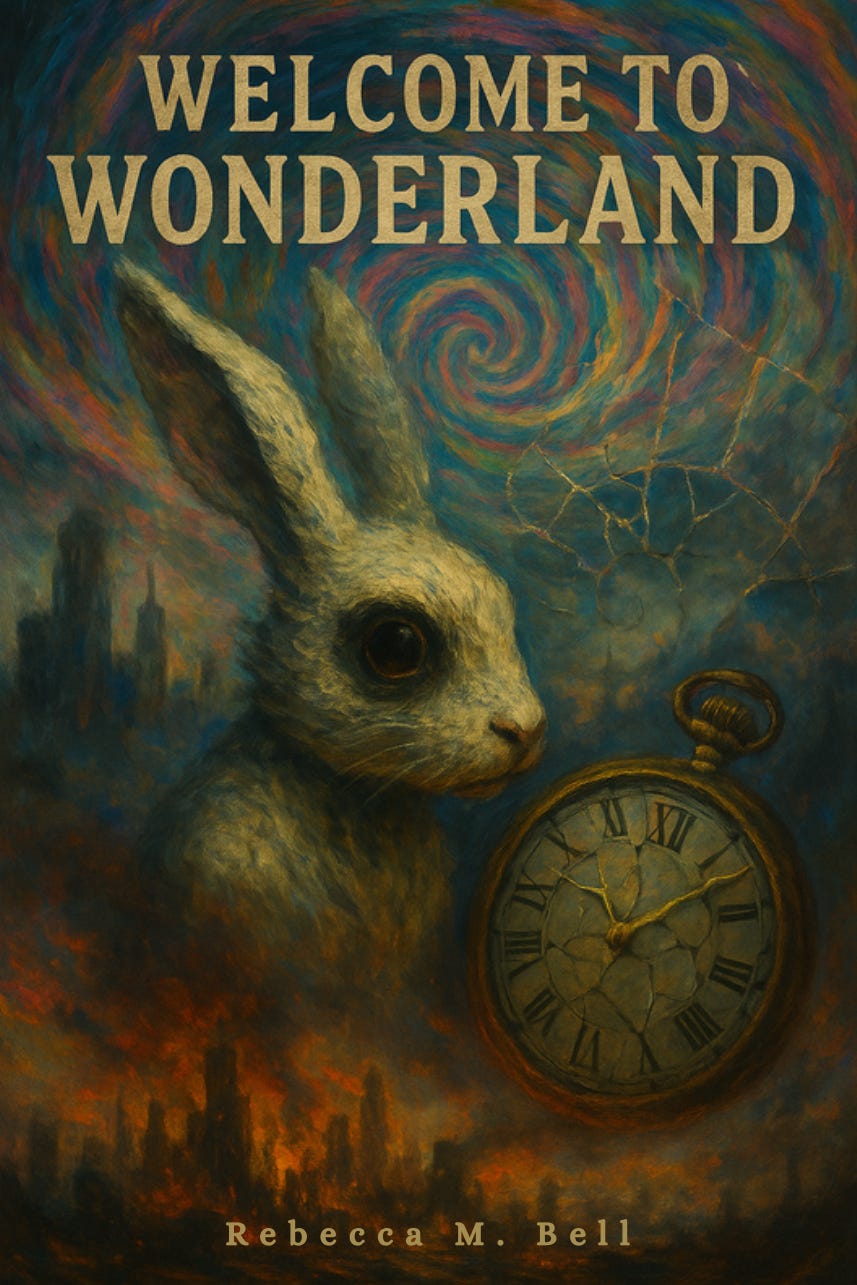
Release Date TBA

Filed under: Allegory, Architecture, Catharsis