


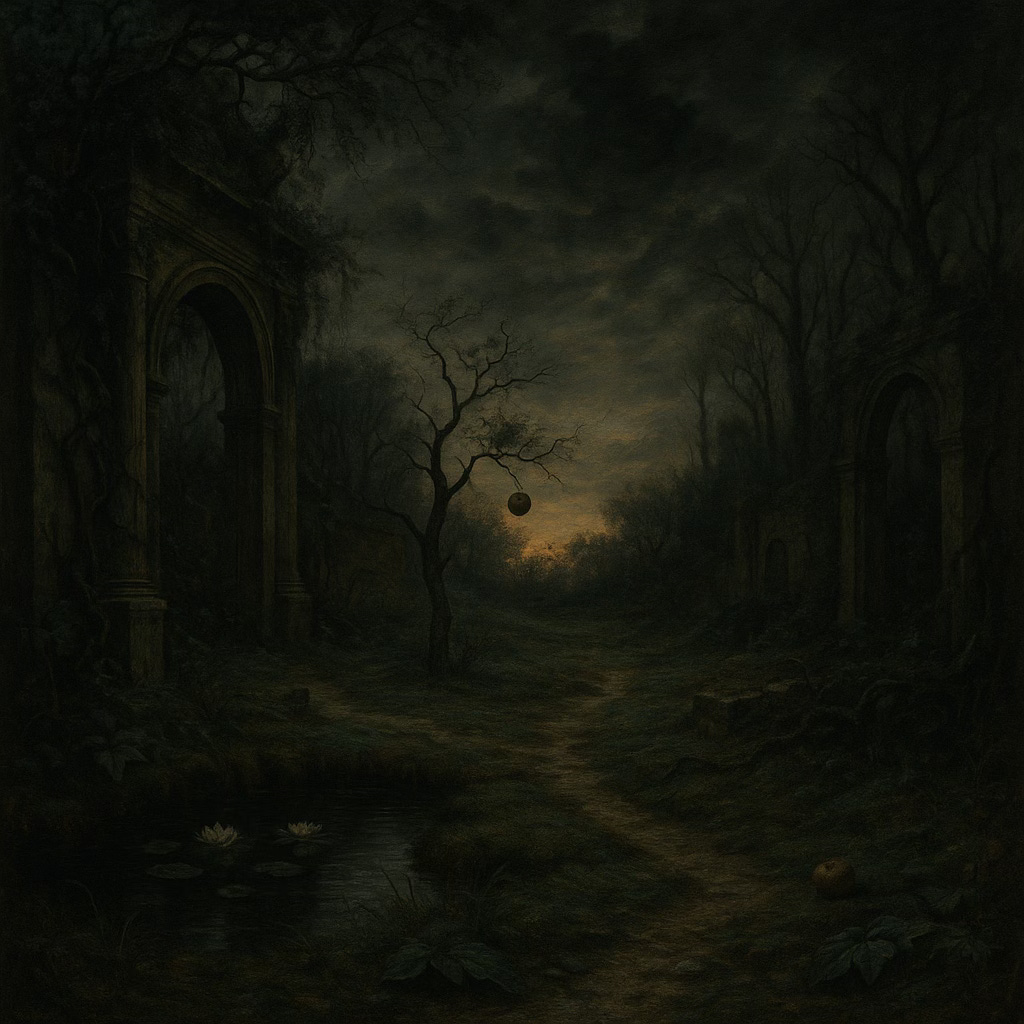
Paradise decays where truth blooms. 🥀
Milton gave Eve guilt. The Book of Genesis gave her blame,
but the silence between those pages always whispered something else.
This is the story as she might have told it—if anyone had asked.
“Eve, Rewritten”
Filed under: literary fiction, myth retold, psychological seduction, feminine awakening
In the beginning,
she was not lonely—
only alone.
Adam was there, of course. Always there.
He walked like the garden belonged to him,
as if his rib had purchased the soil and signed the sky.
He spoke in declarations
and named things as though that was the same as knowing them.
But Eve—
Eve listened.
She heard the pulse behind the petals,
the ache beneath the stillness.
She watched how the vines curled away from his footsteps.
How the animals looked through him, never to him.
The Garden was perfect.
[And so was the silence.]
But silence, she learned, is not the same as peace.
It is only the absence of permission to speak.
She did not speak much, in those first days.
Adam liked it better that way.
When she asked questions, he called them “disruptive.”
When she wondered aloud, he said she was “overthinking.”
When she looked too long at the moon and said it felt lonely,
he laughed.
“Don’t worry your pretty head,” he told her.
“You weren’t made to understand. You were made for me.”
And for a time, she believed him.
Until the day the wind spoke back:
It came as a rustle, then a rhythm—
too intentional to be coincidence.
It moved like thought.
It moved like her.
And in its whisper,
she heard something she’d never been taught:
Her own name.
Not as he said it—clipped and claimed.
Not as He said it—distant and directive.
But as she felt it:
vowel-heavy, ancient, already burning at the edges:
Eve.
She turned—
and there was the serpent.
But he did not slither.
He reclined—coiled in the bough of a tree
with the poise of someone
who had waited for eons
just to be asked a question.
His eyes were not wicked.
They were wide.
“Do you know why He forbade it?”
the serpent asked, gesturing toward the fruit
that pulsed like a heartbeat.
“It’s not poison.
It’s perspective.”
She hesitated.
She had been warned about temptation.
But no one had warned her about resonance—
about what it feels like to hear your own mind
spoken aloud
for the very first time.
“You aren’t what they say you are,” the serpent hissed.
“You are not a helper.
You are a herald.”
Her fingers twitched.
Her stomach stirred.
It wasn’t hunger.
It was remembering.
Remembering what it meant to want.
Adam had never asked what she wanted.
He fed her what He told him to feed her.
He touched her like a routine.
He prayed with her hands clasped between his own,
always guiding the words
as if hers might drift off course.
She reached toward the fruit—
not for rebellion, but for recognition.
And when her teeth broke its skin,
the juice ran down her chin like a baptism.
It was not sweet.
The fruit had a bitterness to it—
fermented, ancient, earned.
It coated her tongue like ash and honey.
She didn’t flinch.
She swallowed.
And then—
everything
shifted.
The Garden didn’t vanish.
It clarified.
The vines sharpened.
The sky cracked wider.
The colors grew louder,
like a painting coming into focus.
The silence, too, was different now.
It quivered.
For the first time, Eve understood:
Eden was not paradise.
It was presentation.
A curated space.
A performance.
And she had been the centerpiece
in someone else’s illusion of control.
The serpent smiled—
not victorious, not smug.
More like a mirror admiring its reflection in a flame.
“You see it now,” he said.
“I always saw it,” she replied.
“I just didn’t have the words.”
And now, the words came.
Not in language—
in knowing.
A surge beneath her skin.
Behind her eyes.
In the soft bend of her wrist.
She could feel the story folding, rethreading.
She was no longer inside it.
She was holding it.
She sat beneath the tree awhile—
long enough to let the sun shift angles
and the leaves cast new shadows across her chest.
She did not wipe the juice from her chin.
Let him see it.
When Adam arrived,
he wore his usual smugness—
shoulders back, jaw clenched,
pride stitched into his skin like a birthright.
“Where have you been?” he asked.
She tilted her head.
“Listening.”
He glanced at the tree.
At the serpent.
At the stain on her lips.
His face darkened.
“What did you do?”
Eve rose slowly.
She did not apologize.
She did not explain.
Instead,
she plucked another fruit—
gentle, precise, like a priestess offering sacrament—
and walked toward him.
“Here,” she said.
He didn’t reach for it.
He stared.
Suspicious. Shaken.
Eve stepped closer.
“It won’t kill you,” she whispered,
her voice all velvet and blade:
“Unless truth does.”
Adam took the fruit,
but his hand trembled.
And for the first time,
she saw it:
He was afraid of her.
Not of damnation.
Not of exile.
Of her.
Of the look in her eyes.
Of the ease with which she had eaten.
Of the fact that she had chosen—without him.
He bit.
He chewed like it was gravel.
He gagged on the aftertaste.
He didn’t understand it—
of course he didn’t.
He had never been hungry.
He said nothing at first.
Just stood there.
As if the bite had hollowed him.
As if the taste of truth
had too many syllables for him to swallow.
She watched.
It wasn’t cruelty.
It was curiosity.
She had never seen Adam before.
Not as a companion.
Not as a name-giver.
Not as the echo of some divine ego…
But as a man.
Just a man.
His certainty had always been a costume.
He mistook obedience for righteousness.
He called her “mine” and believed it holy.
And now—
he looked at her like a question he couldn’t answer.
“You’ve ruined it,” he muttered.
“The Garden. Everything. We were—it was—perfect.”
Eve stepped past him,
her bare feet pressing soft prints into the soil.
“No,” she said.
“It was curated. Controlled. Contained.”
“I didn’t ruin it.
I released it.”“That’s not what He wanted,” Adam said.
She turned, slowly.
“Then perhaps He should’ve made a different woman.”
Something inside him shattered.
Not all at once—
but enough to make space
for the silence to settle in.
She walked.
Not toward redemption.
Not toward wrath.
Just away.
And the world, seeing her for the first time,
held its breath.
The Garden didn’t burn.
It didn’t need to.
It withered slowly,
as if in grief—
not over sin,
but over irrelevance.
She reached the edge.
The gates opened.
She did not flinch.
Behind her,
Adam knelt by the tree, face in his palms,
surrounded by the remains of his mythology.
She didn’t look back.
She didn’t speak.
She just thought—
without bitterness,
without pride,
just truth:
Funny…
he always said I ruined him,
but I only ever left the Garden.
They called it a fall;
She called it a beginning,
— Rebecca M. Bell 🔔
ps. My Dearest Adam,
The fruit didn’t curse me;
your silence did.
And I’m done being quiet.